Tag Archives: Horror book reviews

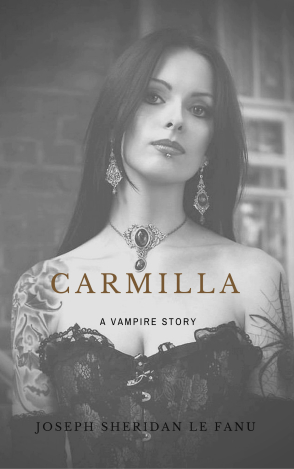
Kageoween: Carmilla Book Review

INTRODUCTION
     Carmilla is one of the earliest vampire stories and the inspiration behind Bram Stoker’s Dracula, apparently. Besides this, the only other known source for vampire mythos prior to Dracula is Varney the Vampire, a penny dreadful, which was sold on the streets for a penny back in the 1800’s.

     Much has been said about this novel, mostly the balls on J. Sheridan LeFanu, for adding Sappho eroticism in a time frame when such would have been on par with child molesting today.

     So, what does it come off as in 2018 and is it really any good? The answer, probably won’t surprise you!

STORY
     A young woman lives with a family when strange occurrences start to, well, occur, leading to a less than suspenseful build up to the climax of wow, vampire.

PROSE
     The prose has moments of sheer beauty throughout its page. If written in a modern voice, I think the story would fail even more. Part of the charm is that 1800’s style narration with beautiful prose in some places and misplaced telling aspects that could of be written better.

CHARACTERS
     The characters are mostly shallow, but still enough to get an idea for their personalities. No one character really sticks out in my mind, except for the father of the young woman who is friends with the vampress title character. He is a weird scientist of sorts and I don’t mean a literal scientist, I mean, he looks for the simplest explanation of a situation, but in the same breathe is glad that it wasn’t witches. I like this weird, juxtaposition between science and superstition. The original inspiration for Van Helsing is also present, but he isn’t as developed as he is in Dracula, but you can see where the inspiration came from, but it was less homage and more a “Hold my beer” moment, as Bram Stoker showcased he could do it better.

SUBTEXT
     Unlike other reviewers, most of whom are also male, I don’t find lesbianism to be a subtext of this book. I think it is inferred by men with an inkling of homoeroticism for other men, who have projected their desires on two characters.

     I know Vampires are known for their sensual nature, but they’re predators mostly, they’re also dead, thus they really don’t have a sexuality at all. I also find it weird that these same reviewers never spot male homosexual subtext in Dracula or other novels about vampires. Interview with the Vampire comes to mind with blatant male homoerotism, of which no one ever points out or holds up in esteem. The homosexuality is especially noticeable in the movie of Interview with the Vampire, where the sexual ambiguity between Brad Pitt and Tom Cruise is so thick, you could cut the fuckin thing with a knife. Just like this book, 90’s male homosexuality would have been considered loathsome and horrible, but no praise for pushing the envelope there.

CONCLUSION
     This book is really short and sparse of form, while giving some of the future tropes for the vampire mythos that we either all know and love or find to be horrible clichés. I wouldn’t say Bram Stoker was so much inspired by it, as being a flat out plagiarist on quite a bit, while extrapolating with better fleshed out characters, subtext and themes. Ironically, Bram himself would later be plagiarized with Nosferatu, a lawsuit ensued which he would win, even though he really had no grounds, notwithstanding his own plagiarism. Still, the story is good, the prose is decent and while the lesbian subtext is inferred by Horny men, the book still has a lot going for it and is well worth picking up.

3 out of 5 stars.

Kageoween: Frankenstein Book Review

INTRODUCTION

     Frankenstein, for all the pop culture surrounding it, isn’t a horror novel. Not in the traditional sense anyways. I see that as a shallow view of the book and a literal interpretation. Much has been said over the years about it dealing with fear of technology, science and modern advancement and given the history of the era, one cannot be faulted for thinking such, especially because Christianity still had a massive foothold. What about the book in 2018 though? If anything, Frankenstein is about the horror of humanity and its decrepit ugliness towards anything that is left of center or queer and the plight of humanity vs growth.

     The book follows multiple narratives and interweaves an intriguing story that really only drags in the middle. The rest of the book advances at a great pace and tells the story with prose that is stylistic, as opposed to seeming outdated. It’s quite easy to understand, although the narrative switch for me, wasn’t exactly clear at one point. Despite all that, the book and its central themes are fantastic with very little to complain about.

CHARACTERS
     The book has three main point of views, Victor Frankenstein as told through a primary narrator named Robert Wolton, the monster itself and various others through letters. Legend has it that the book was created as the result of a party were all guest agreed to write a horror story and this is the result of such. Marry Shelly was alleged to have struggled with coming up with an idea, which the multiple point of views tend to allude to.

     Victor Frankenstein has the most development of all the characters with the monster coming in second place. Everyone else, even when they seem important to the plot, are kind of just there. Not like background characters, but given the fact they have names and we’re exposed to some of their history through exposition, one would think they would have been important enough to warrant more development then they had.

STYLE AND PLOT
     Having been written 200 years ago, the prose hold up, very well. It’s similar to the modern novel in a lot of ways by exhibiting concise, basic prose, but still with evocative imagery, so that allows anyone to follow along with the story. Very accessible to the average reader with enough depth to satisfy anyone who demands more from their lit.

     The overall plot, if you can call it that, is as follows: Dr.Frankenstein created a being from unknown science, his monster took on a mind of his own. The monster taught himself to read, speak and learn. Unable to live in society, he is basically exiled and doomed to a life of loneliness, when returns to ask the good doctor to make another in his image and is refused, turning the monster to enact revenge upon him, which results in the death of both.

THEMES
     Besides writing, the themes is where the story is truly at. One could cull so many different interpretations from this work. It could be seen as the story of Lucifer, cast from heaven, making the renegade angel of enlightenment a lot more sympathetic. Given the time frame though, I doubt Mary Shelly or anyone would of consider admitting to such. One can view this as being a woman in the time frame, constantly turned away from manly endeavors that they’re just not built for, which is why this book was originally published anonymously, I’m sure and only bore her name years later.

     Other interpretations could be relating to being a monster or outcast as a teenager or in our modern area, being an Incel, since the monster is very much Incel like in demeanor with similar demands for a wife.

     Still, none of these seem like very good interpretations, but a few are dated. My own personal interpretation is the monster is representative of intellectualism, which is why the monster’s story is similar to Lucifer in the bible. There is innumerable evidence to back this up, including, but not limited to: The monster rebelling against his creator, the love for learning, being cast out and most importantly being misunderstood by the more emotional humans that plague the lands of this tale. Frankenstein is doing his best to live in a world that values emotion over logic and intelligence and is doing a poor job at such. No matter what, he is constantly exiled and seen as a monstrosity.

     When a young woman is executed for murder of a young child, the monster is undoubtedly to blame. This is fantastic use of metaphor, since the monster is intellect and the child is innocents and people fear that knowledge would lead to a loss of that innocence. So not only are the townspeople enraged, but they are also hasty to point the finger and hang an innocent woman.

     Almost every negative thing in this book is a direct cause of others letting their emotion rule them as opposed to being in control of themselves. They project their worst habits on the monster, enough though the monster is never really described. It leaves one to see the monster as the hero instead of everyone around him, who are all too willing kill, point the finger, flip out or destroy someone without due cause. It is the intriguing concept of humanity in all forms that really drives the narrative and makes it an enjoyable read.

CONCLUSION
     Frankenstein isn’t horror and the idea it is, 200 years on, is ashame. It’s called the original science fiction novel and while it has those tropes, I wouldn’t call it that either, since Sci-fi is often denoted by its obsession with technology. In a lot of ways, it is a gothic weird tale, but even that doesn’t really do the story justice in terms of describing it. The only way to really describe it, would be to call it what it is, that is character driven lit and our attitudes, prejudices and intolerance to difference in this world, no matter the era that keep this book being reprinted over and over again, to be enjoy and inspire future generations.
Five out of Five Stars